
 #practiceLinkDiv { display: none! importante; }
L'algoritmo di eliminazione inversa è strettamente correlato a Algoritmo di Kruskal . Nell'algoritmo di Kruskal ciò che facciamo è: ordinare i bordi in ordine crescente del loro peso. Dopo l'ordinamento, scegliamo uno per uno i bordi in ordine crescente. Includiamo il bordo selezionato corrente se includendolo nello spanning tree non si forma alcun ciclo finché non ci sono bordi V-1 nello spanning tree dove V = numero di vertici.
Nell'algoritmo Reverse Delete ordiniamo tutti i bordi decrescente ordine dei loro pesi. Dopo l'ordinamento, scegliamo uno per uno i bordi in ordine decrescente. Noi includere il bordo corrente selezionato se l'esclusione del bordo corrente provoca la disconnessione nel grafico corrente . L'idea principale è eliminare il bordo se la sua eliminazione non porta alla disconnessione del grafico.
valore Java dell'enum
L'algoritmo:
- Ordina tutti i bordi del grafico in ordine non crescente di peso dei bordi.
- Inizializza MST come grafico originale e rimuovi i bordi aggiuntivi utilizzando il passaggio 3.
- Scegli il bordo di peso più alto dai bordi rimanenti e controlla se l'eliminazione del bordo disconnette il grafico o meno .
Se si disconnette, non eliminiamo il bordo.
Altrimenti eliminiamo il bordo e continuiamo.
Illustrazione:
Cerchiamo di capirlo con il seguente esempio:
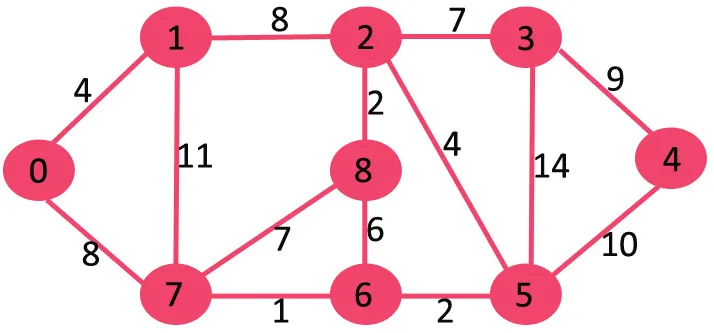
Se eliminiamo il bordo di peso più alto del peso 14, il grafico non viene disconnesso, quindi lo rimuoviamo.
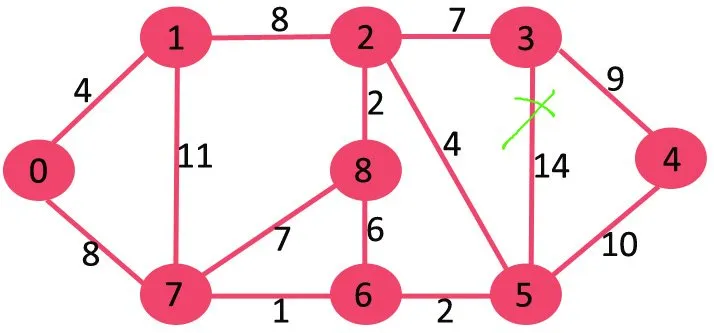
Successivamente eliminiamo 11 poiché l'eliminazione non disconnette il grafico.
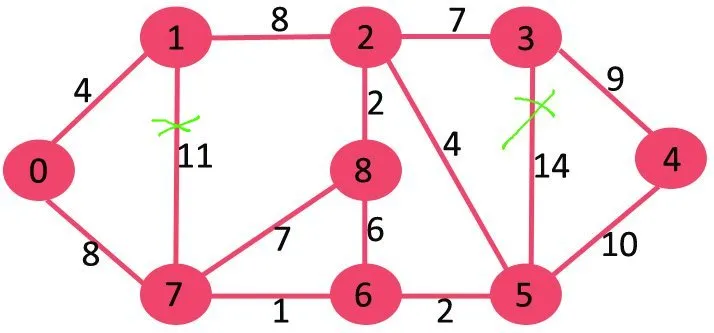
Successivamente eliminiamo 10 poiché l'eliminazione non disconnette il grafico.

Il successivo è 9. Non possiamo eliminare 9 poiché l'eliminazione provoca la disconnessione.

testo a capo con CSS
Continuiamo in questo modo e i bordi successivi rimangono nel MST finale.
Edges in MST
(3 4)
(0 7)
(2 3)
(2 5)
(0 1)
(5 6)
(2 8)
(6 7)
Nota: In caso di bordi dello stesso peso possiamo scegliere qualsiasi bordo dei bordi dello stesso peso.
Pratica consigliata Algoritmo di eliminazione inversa per lo spanning tree minimo Provalo!Attuazione:
C++// C++ program to find Minimum Spanning Tree // of a graph using Reverse Delete Algorithm #include
// Java program to find Minimum Spanning Tree // of a graph using Reverse Delete Algorithm import java.util.*; // class to represent an edge class Edge implements Comparable<Edge> { int u v w; Edge(int u int v int w) { this.u = u; this.w = w; this.v = v; } public int compareTo(Edge other) { return (this.w - other.w); } } // Class to represent a graph using adjacency list // representation public class GFG { private int V; // No. of vertices private List<Integer>[] adj; private List<Edge> edges; @SuppressWarnings({ 'unchecked' 'deprecated' }) public GFG(int v) // Constructor { V = v; adj = new ArrayList[v]; for (int i = 0; i < v; i++) adj[i] = new ArrayList<Integer>(); edges = new ArrayList<Edge>(); } // function to Add an edge public void AddEdge(int u int v int w) { adj[u].add(v); // Add w to v’s list. adj[v].add(u); // Add w to v’s list. edges.add(new Edge(u v w)); } // function to perform dfs private void DFS(int v boolean[] visited) { // Mark the current node as visited and print it visited[v] = true; // Recur for all the vertices adjacent to // this vertex for (int i : adj[v]) { if (!visited[i]) DFS(i visited); } } // Returns true if given graph is connected else false private boolean IsConnected() { boolean[] visited = new boolean[V]; // Find all reachable vertices from first vertex DFS(0 visited); // If set of reachable vertices includes all // return true. for (int i = 1; i < V; i++) { if (visited[i] == false) return false; } return true; } // This function assumes that edge (u v) // exists in graph or not public void ReverseDeleteMST() { // Sort edges in increasing order on basis of cost Collections.sort(edges); int mst_wt = 0; // Initialize weight of MST System.out.println('Edges in MST'); // Iterate through all sorted edges in // decreasing order of weights for (int i = edges.size() - 1; i >= 0; i--) { int u = edges.get(i).u; int v = edges.get(i).v; // Remove edge from undirected graph adj[u].remove(adj[u].indexOf(v)); adj[v].remove(adj[v].indexOf(u)); // Adding the edge back if removing it // causes disconnection. In this case this // edge becomes part of MST. if (IsConnected() == false) { adj[u].add(v); adj[v].add(u); // This edge is part of MST System.out.println('(' + u + ' ' + v + ')'); mst_wt += edges.get(i).w; } } System.out.println('Total weight of MST is ' + mst_wt); } // Driver code public static void main(String[] args) { // create the graph given in above figure int V = 9; GFG g = new GFG(V); // making above shown graph g.AddEdge(0 1 4); g.AddEdge(0 7 8); g.AddEdge(1 2 8); g.AddEdge(1 7 11); g.AddEdge(2 3 7); g.AddEdge(2 8 2); g.AddEdge(2 5 4); g.AddEdge(3 4 9); g.AddEdge(3 5 14); g.AddEdge(4 5 10); g.AddEdge(5 6 2); g.AddEdge(6 7 1); g.AddEdge(6 8 6); g.AddEdge(7 8 7); g.ReverseDeleteMST(); } } // This code is contributed by Prithi_Dey
# Python3 program to find Minimum Spanning Tree # of a graph using Reverse Delete Algorithm # Graph class represents a directed graph # using adjacency list representation class Graph: def __init__(self v): # No. of vertices self.v = v self.adj = [0] * v self.edges = [] for i in range(v): self.adj[i] = [] # function to add an edge to graph def addEdge(self u: int v: int w: int): self.adj[u].append(v) # Add w to v’s list. self.adj[v].append(u) # Add w to v’s list. self.edges.append((w (u v))) def dfs(self v: int visited: list): # Mark the current node as visited and print it visited[v] = True # Recur for all the vertices adjacent to # this vertex for i in self.adj[v]: if not visited[i]: self.dfs(i visited) # Returns true if graph is connected # Returns true if given graph is connected else false def connected(self): visited = [False] * self.v # Find all reachable vertices from first vertex self.dfs(0 visited) # If set of reachable vertices includes all # return true. for i in range(1 self.v): if not visited[i]: return False return True # This function assumes that edge (u v) # exists in graph or not def reverseDeleteMST(self): # Sort edges in increasing order on basis of cost self.edges.sort(key = lambda a: a[0]) mst_wt = 0 # Initialize weight of MST print('Edges in MST') # Iterate through all sorted edges in # decreasing order of weights for i in range(len(self.edges) - 1 -1 -1): u = self.edges[i][1][0] v = self.edges[i][1][1] # Remove edge from undirected graph self.adj[u].remove(v) self.adj[v].remove(u) # Adding the edge back if removing it # causes disconnection. In this case this # edge becomes part of MST. if self.connected() == False: self.adj[u].append(v) self.adj[v].append(u) # This edge is part of MST print('( %d %d )' % (u v)) mst_wt += self.edges[i][0] print('Total weight of MST is' mst_wt) # Driver Code if __name__ == '__main__': # create the graph given in above figure V = 9 g = Graph(V) # making above shown graph g.addEdge(0 1 4) g.addEdge(0 7 8) g.addEdge(1 2 8) g.addEdge(1 7 11) g.addEdge(2 3 7) g.addEdge(2 8 2) g.addEdge(2 5 4) g.addEdge(3 4 9) g.addEdge(3 5 14) g.addEdge(4 5 10) g.addEdge(5 6 2) g.addEdge(6 7 1) g.addEdge(6 8 6) g.addEdge(7 8 7) g.reverseDeleteMST() # This code is contributed by # sanjeev2552
// C# program to find Minimum Spanning Tree // of a graph using Reverse Delete Algorithm using System; using System.Collections.Generic; // class to represent an edge public class Edge : IComparable<Edge> { public int u v w; public Edge(int u int v int w) { this.u = u; this.v = v; this.w = w; } public int CompareTo(Edge other) { return this.w.CompareTo(other.w); } } // Graph class represents a directed graph // using adjacency list representation public class Graph { private int V; // No. of vertices private List<int>[] adj; private List<Edge> edges; public Graph(int v) // Constructor { V = v; adj = new List<int>[ v ]; for (int i = 0; i < v; i++) adj[i] = new List<int>(); edges = new List<Edge>(); } // function to Add an edge public void AddEdge(int u int v int w) { adj[u].Add(v); // Add w to v’s list. adj[v].Add(u); // Add w to v’s list. edges.Add(new Edge(u v w)); } // function to perform dfs private void DFS(int v bool[] visited) { // Mark the current node as visited and print it visited[v] = true; // Recur for all the vertices adjacent to // this vertex foreach(int i in adj[v]) { if (!visited[i]) DFS(i visited); } } // Returns true if given graph is connected else false private bool IsConnected() { bool[] visited = new bool[V]; // Find all reachable vertices from first vertex DFS(0 visited); // If set of reachable vertices includes all // return true. for (int i = 1; i < V; i++) { if (visited[i] == false) return false; } return true; } // This function assumes that edge (u v) // exists in graph or not public void ReverseDeleteMST() { // Sort edges in increasing order on basis of cost edges.Sort(); int mst_wt = 0; // Initialize weight of MST Console.WriteLine('Edges in MST'); // Iterate through all sorted edges in // decreasing order of weights for (int i = edges.Count - 1; i >= 0; i--) { int u = edges[i].u; int v = edges[i].v; // Remove edge from undirected graph adj[u].Remove(v); adj[v].Remove(u); // Adding the edge back if removing it // causes disconnection. In this case this // edge becomes part of MST. if (IsConnected() == false) { adj[u].Add(v); adj[v].Add(u); // This edge is part of MST Console.WriteLine('({0} {1})' u v); mst_wt += edges[i].w; } } Console.WriteLine('Total weight of MST is {0}' mst_wt); } } class GFG { // Driver code static void Main(string[] args) { // create the graph given in above figure int V = 9; Graph g = new Graph(V); // making above shown graph g.AddEdge(0 1 4); g.AddEdge(0 7 8); g.AddEdge(1 2 8); g.AddEdge(1 7 11); g.AddEdge(2 3 7); g.AddEdge(2 8 2); g.AddEdge(2 5 4); g.AddEdge(3 4 9); g.AddEdge(3 5 14); g.AddEdge(4 5 10); g.AddEdge(5 6 2); g.AddEdge(6 7 1); g.AddEdge(6 8 6); g.AddEdge(7 8 7); g.ReverseDeleteMST(); } } // This code is contributed by cavi4762
// Javascript program to find Minimum Spanning Tree // of a graph using Reverse Delete Algorithm // Graph class represents a directed graph // using adjacency list representation class Graph { // Constructor constructor(V) { this.V = V; this.adj = []; this.edges = []; for (let i = 0; i < V; i++) { this.adj[i] = []; } } // function to add an edge to graph addEdge(u v w) { this.adj[u].push(v);// Add w to v’s list. this.adj[v].push(u);// Add w to v’s list. this.edges.push([w [u v]]); } DFS(v visited) { // Mark the current node as visited and print it visited[v] = true; for (const i of this.adj[v]) { if (!visited[i]) { this.DFS(i visited); } } } // Returns true if given graph is connected else false isConnected() { const visited = []; for (let i = 0; i < this.V; i++) { visited[i] = false; } // Find all reachable vertices from first vertex this.DFS(0 visited); // If set of reachable vertices includes all // return true. for (let i = 1; i < this.V; i++) { if (!visited[i]) { return false; } } return true; } // This function assumes that edge (u v) // exists in graph or not reverseDeleteMST() { // Sort edges in increasing order on basis of cost this.edges.sort((a b) => a[0] - b[0]); let mstWt = 0;// Initialize weight of MST console.log('Edges in MST'); // Iterate through all sorted edges in // decreasing order of weights for (let i = this.edges.length - 1; i >= 0; i--) { const [u v] = this.edges[i][1]; // Remove edge from undirected graph this.adj[u] = this.adj[u].filter(x => x !== v); this.adj[v] = this.adj[v].filter(x => x !== u); // Adding the edge back if removing it // causes disconnection. In this case this // edge becomes part of MST. if (!this.isConnected()) { this.adj[u].push(v); this.adj[v].push(u); // This edge is part of MST console.log(`(${u} ${v})`); mstWt += this.edges[i][0]; } } console.log(`Total weight of MST is ${mstWt}`); } } // Driver code function main() { // create the graph given in above figure var V = 9; var g = new Graph(V); // making above shown graph g.addEdge(0 1 4); g.addEdge(0 7 8); g.addEdge(1 2 8); g.addEdge(1 7 11); g.addEdge(2 3 7); g.addEdge(2 8 2); g.addEdge(2 5 4); g.addEdge(3 4 9); g.addEdge(3 5 14); g.addEdge(4 5 10); g.addEdge(5 6 2); g.addEdge(6 7 1); g.addEdge(6 8 6); g.addEdge(7 8 7); g.reverseDeleteMST(); } main();
Produzione
Edges in MST (3 4) (0 7) (2 3) (2 5) (0 1) (5 6) (2 8) (6 7) Total weight of MST is 37
Complessità temporale: O((E*(V+E)) + E log E) dove E è il numero di spigoli.
Complessità spaziale: O(V+E) dove V è il numero di vertici ed E è il numero di spigoli. Stiamo utilizzando la lista di adiacenza per memorizzare il grafico, quindi abbiamo bisogno di spazio proporzionale a O(V+E).
Note:
- L'implementazione di cui sopra è un'implementazione semplice/ingenua dell'algoritmo di eliminazione inversa e può essere ottimizzata su O(E log V (log log V)3) [Fonte : Una settimana ]. Ma questa complessità temporale ottimizzata è ancora inferiore a Primo E Kruskal Algoritmi per MST.
- L'implementazione di cui sopra modifica il grafico originale. Possiamo creare una copia del grafico se è necessario conservare il grafico originale.
Crea quiz