
Prerequisito: Metodi di allocazione delle partizioni
Worst Fit assegna un processo alla partizione sufficientemente più grande tra le partizioni liberamente disponibili nella memoria principale. Se un processo di grandi dimensioni arriva in una fase successiva, la memoria non avrà spazio per accoglierlo.
Esempio:
Input : blockSize[] = {100 500 200 300 600}; processSize[] = {212 417 112 426}; Output: Process No. Process Size Block no. 1 212 5 2 417 2 3 112 5 4 426 Not Allocated
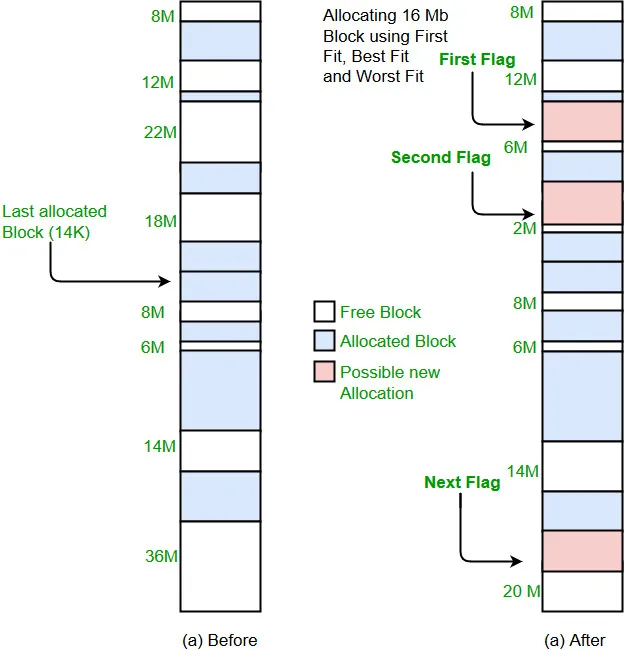
Implementation: 1- Input memory blocks and processes with sizes. 2- Initialize all memory blocks as free. 3- Start by picking each process and find the maximum block size that can be assigned to current process i.e. find max(bockSize[1] blockSize[2].....blockSize[n]) > processSize[current] if found then assign it to the current process. 5- If not then leave that process and keep checking the further processes.
Di seguito è riportata l'implementazione dei passaggi precedenti.
C++// C++ implementation of worst - Fit algorithm #include
// Java implementation of worst - Fit algorithm public class GFG { // Method to allocate memory to blocks as per worst fit // algorithm static void worstFit(int blockSize[] int m int processSize[] int n) { // Stores block id of the block allocated to a // process int allocation[] = new int[n]; // Initially no block is assigned to any process for (int i = 0; i < allocation.length; i++) allocation[i] = -1; // pick each process and find suitable blocks // according to its size ad assign to it for (int i=0; i<n; i++) { // Find the best fit block for current process int wstIdx = -1; for (int j=0; j<m; j++) { if (blockSize[j] >= processSize[i]) { if (wstIdx == -1) wstIdx = j; else if (blockSize[wstIdx] < blockSize[j]) wstIdx = j; } } // If we could find a block for current process if (wstIdx != -1) { // allocate block j to p[i] process allocation[i] = wstIdx; // Reduce available memory in this block. blockSize[wstIdx] -= processSize[i]; } } System.out.println('nProcess No.tProcess SizetBlock no.'); for (int i = 0; i < n; i++) { System.out.print(' ' + (i+1) + 'tt' + processSize[i] + 'tt'); if (allocation[i] != -1) System.out.print(allocation[i] + 1); else System.out.print('Not Allocated'); System.out.println(); } } // Driver Method public static void main(String[] args) { int blockSize[] = {100 500 200 300 600}; int processSize[] = {212 417 112 426}; int m = blockSize.length; int n = processSize.length; worstFit(blockSize m processSize n); } }
# Python3 implementation of worst - Fit algorithm # Function to allocate memory to blocks as # per worst fit algorithm def worstFit(blockSize m processSize n): # Stores block id of the block # allocated to a process # Initially no block is assigned # to any process allocation = [-1] * n # pick each process and find suitable blocks # according to its size ad assign to it for i in range(n): # Find the best fit block for # current process wstIdx = -1 for j in range(m): if blockSize[j] >= processSize[i]: if wstIdx == -1: wstIdx = j elif blockSize[wstIdx] < blockSize[j]: wstIdx = j # If we could find a block for # current process if wstIdx != -1: # allocate block j to p[i] process allocation[i] = wstIdx # Reduce available memory in this block. blockSize[wstIdx] -= processSize[i] print('Process No. Process Size Block no.') for i in range(n): print(i + 1 ' ' processSize[i] end = ' ') if allocation[i] != -1: print(allocation[i] + 1) else: print('Not Allocated') # Driver code if __name__ == '__main__': blockSize = [100 500 200 300 600] processSize = [212 417 112 426] m = len(blockSize) n = len(processSize) worstFit(blockSize m processSize n) # This code is contributed by PranchalK
// C# implementation of worst - Fit algorithm using System; class GFG { // Method to allocate memory to blocks // as per worst fit algorithm static void worstFit(int []blockSize int m int []processSize int n) { // Stores block id of the block allocated to a // process int []allocation = new int[n]; // Initially no block is assigned to any process for (int i = 0; i < allocation.Length; i++) allocation[i] = -1; // pick each process and find suitable blocks // according to its size ad assign to it for (int i = 0; i < n; i++) { // Find the best fit block for current process int wstIdx = -1; for (int j = 0; j < m; j++) { if (blockSize[j] >= processSize[i]) { if (wstIdx == -1) wstIdx = j; else if (blockSize[wstIdx] < blockSize[j]) wstIdx = j; } } // If we could find a block for current process if (wstIdx != -1) { // allocate block j to p[i] process allocation[i] = wstIdx; // Reduce available memory in this block. blockSize[wstIdx] -= processSize[i]; } } Console.WriteLine('nProcess No.tProcess SizetBlock no.'); for (int i = 0; i < n; i++) { Console.Write(' ' + (i+1) + 'ttt' + processSize[i] + 'ttt'); if (allocation[i] != -1) Console.Write(allocation[i] + 1); else Console.Write('Not Allocated'); Console.WriteLine(); } } // Driver code public static void Main(String[] args) { int []blockSize = {100 500 200 300 600}; int []processSize = {212 417 112 426}; int m = blockSize.Length; int n = processSize.Length; worstFit(blockSize m processSize n); } } // This code has been contributed by 29AjayKumar
<script> // Javascript implementation of // worst - Fit algorithm // Method to allocate memory to  // blocks as per worst fit // algorithm function worstFit(blockSize m   processSize n) {    // Stores block id of the block allocated  // to a process  let allocation = new Array(n);    // Initially no block is assigned  // to any process  for(let i = 0; i < allocation.length; i++)  allocation[i] = -1;    // Pick each process and find suitable blocks  // according to its size ad assign to it  for(let i = 0; i < n; i++)  {    // Find the best fit block  // for current process  let wstIdx = -1;  for(let j = 0; j < m; j++)  {  if (blockSize[j] >= processSize[i])  {  if (wstIdx == -1)  wstIdx = j;  else if (blockSize[wstIdx] <  blockSize[j])  wstIdx = j;  }  }    // If we could find a block for  // current process  if (wstIdx != -1)  {    // Allocate block j to p[i] process  allocation[i] = wstIdx;    // Reduce available memory in this block.  blockSize[wstIdx] -= processSize[i];  }  }    document.write('
Process No.  ' +  ' Process Size  ' +  ' Block no.
');  for(let i = 0; i < n; i++)  {  document.write(' ' + (i + 1) +   '     ' +  '    ' +   processSize[i] +   '      ');  if (allocation[i] != -1)  document.write(allocation[i] + 1);  else  document.write('Not Allocated');    document.write('
');  } } // Driver code let blockSize = [ 100 500 200 300 600 ]; let processSize = [ 212 417 112 426 ]; let m = blockSize.length; let n = processSize.length; worstFit(blockSize m processSize n); // This code is contributed by rag2127 </script>
Produzione
Process No. Process Size Block no. 1 212 5 2 417 2 3 112 5 4 426 Not Allocated
Complessità temporale: O(N*M) dove N è la lunghezza di processSize e M è la lunghezza di blockSize.
Spazio ausiliario: SU)